World Gold Council Reveals Gold Trends for 2026, Highlighting Factors That May Affect Gold Prices in Thailand and Globally This Year
Gold experienced an astonishing phenomenon in 2025, setting new records over 50 times and generating an annual return exceeding 60%. This marks the strongest annual return since 1971. Although current market estimates suggest that gold prices will remain range-bound, history indicates that macroeconomic conditions often do not align with market expectations. Shaokai Fan, Head of Asia Pacific (excluding China) and Global Central Banking at the World Gold Council, analyzed three scenarios for gold, covering moderate positive, high positive, and negative impacts.
Increasing geopolitical and economic uncertainties, coupled with a weakening US dollar, have driven demand for gold as investors seek tools to hedge against volatility and inflation, resulting in significant price momentum in 2025. As the bond market stagnated and the stock market became highly concentrated, investors from all regions globally participated in this growth.
Gold demand in Thailand demonstrated remarkable strength in 2025, with the third quarter being the strongest of the year. Gold continues to affirm its status as the asset of choice for Thai investors amid rising economic and political uncertainties.
Thai investors view gold as a means to preserve value and provide long-term returns, as evidenced by the third-quarter gold demand trend report for 2025, which showed a 25% increase in investments in gold bars and coins compared to the previous year, marking the highest demand since the first quarter of 2022.
Outlook for 2026
Most markets expect the situation to continue in the same direction. However, ongoing macroeconomic disparities and geopolitical volatility cannot overlook the possibility of unexpected severe events.
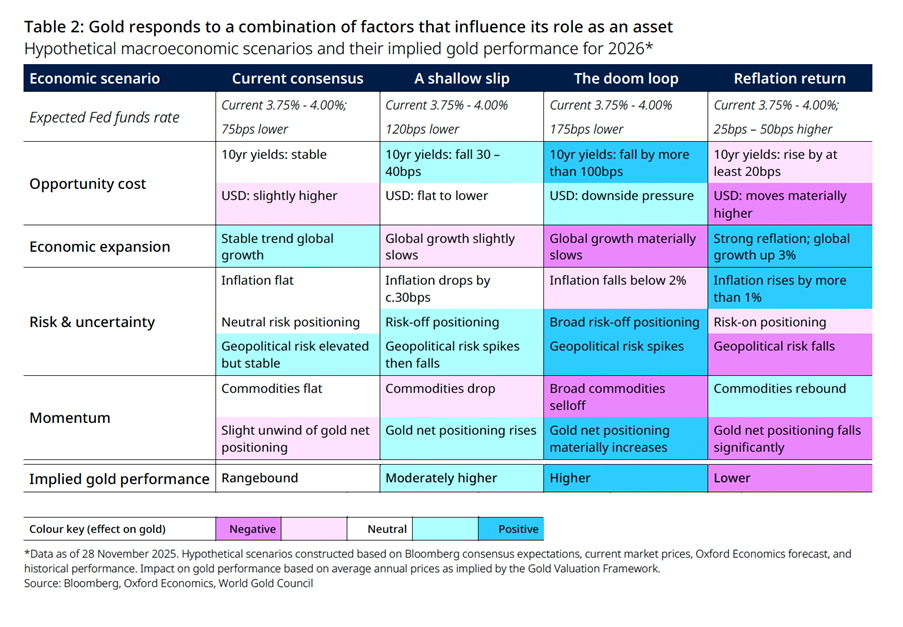
Under such circumstances, the full report on the 2026 outlook from the World Gold Council analyzes three potential scenarios beyond market expectations:
- Moderate Economic Slowdown Scenario (Moderate Positive Outlook)
In this scenario, US economic data shows signs of a slowdown, prompting investors to shift towards more defensive investments. Adjustments in AI forecasts may pressure the stock market, increase volatility, and impact a weakening labor market, along with reduced consumer spending. The US Federal Reserve is likely to respond by cutting interest rates more than the market anticipates due to easing inflationary pressures.
The impact on gold in this scenario would be moderately positive, creating an environment conducive to sustained gold demand and price increases. WGC analysis indicates that under such conditions, gold prices could rise between 5% and 15% from current levels, depending on the magnitude of interest rate cuts and the severity of the economic slowdown.
Central banks will continue to purchase gold, and new investors may enter the market, such as insurance companies from China or pension funds from India.
An increase in gold prices between 5% and 15% is considered a satisfactory return and a normal year, but given the outstanding performance in 2025, it is still a growth to watch closely.
- Doom Loop Scenario (Positive Outlook)
In this scenario, the economy is expected to be most negatively impacted, yet it would also be most favorable for gold prices, reflecting the possibility of a more severe global economic slowdown. Geopolitical risks may escalate as conflicts in various regions remain unresolved or new crisis points emerge, further undermining confidence.
This scenario may coincide with trade tensions, leading to a fragmentation of the market environment and impacting confidence and investment.
If US growth weakens and inflation falls below target, this 'dark and gloomy' scenario could lead to aggressive interest rate cuts, resulting in a weaker US dollar and significantly lower long-term yields.
These factors creating a 'doom loop' would provide strong support for gold as investors seek safety in this scenario, with prices potentially rising rapidly by 15% to 30% within 2026.
Gold ETFs, which saw inflows of up to $77 billion between January and November 2025, may be the primary asset class benefiting from this scenario, helping to offset potentially weak gold demand in other market sectors, such as jewelry or technology.
- Return of Reflation
This scenario represents the most negative outlook for gold prices, where the economic policies of the Trump administration succeed in generating stronger-than-expected growth.
Reflation would return and drive global economic growth to higher levels, prompting the US Federal Reserve to maintain or even raise interest rates in 2026. Such a scenario would push long-term bond yields higher and strengthen the US dollar, increasing the opportunity cost of holding gold and driving capital back into US assets.
Gold ETFs would face continuous outflows as investors shift towards stocks and higher-yielding assets.
All these factors would negatively impact gold prices, leading to a decline of 5% to 20% from current levels. Higher opportunity costs, confidence in risk assets, and downward price pressures could create a challenging environment for gold if these reflation scenarios materialize.
Volatility Factors
Demand from central banks, a key driver of gold demand in 2025, may face increased uncertainty. While there is a high likelihood that central banks will continue purchasing gold, the buying process is often dictated by policy rather than market conditions alone.
If central banks slow their purchases, it could negatively impact gold prices.
Another volatility factor to watch is the volume of recycled gold for jewelry and technology applications, as recycling gold for use instead of mining has been low in 2025 due to increased use of gold as loan collateral.
Conclusion
The global gold price outlook for 2026 remains uncertain, as reflected in Thailand through domestic policy adjustments aimed at enhancing financial stability and increasing transparency in the Thai gold market. For example, regulatory measures concerning gold transactions traded both in markets and online, as well as data reporting, aim to enhance overall transparency and regulatory discipline.
Amid such circumstances, investors will have differing views on the direction of global economic development in 2026. Considering these perspectives against the three scenarios outlined in the 2026 gold outlook report will provide a clearer picture of gold's role in assessing and forecasting investment portfolios.
In a world where volatility and unexpected events are becoming increasingly common, gold's potential for risk diversification and protection of investments in downturns remains as crucial as ever.
[1] Based on overall forecasts and the WGC's gold valuation model, further details can be found at Gold Outlook 2026: Push ahead or pull back | World Gold Council
[2] The hypothetical impacts on gold under various macroeconomic scenarios presented here have been processed from the WGC's Gold Valuation Framework, referencing various relevant factors. More details can be found in the article Gold Outlook 2026: Push ahead or pull back | World Gold Council